



The Ghost Who Balks

Suzette Chan asks whether the Phantom has evolved with the times:
"While the character has a reputation as being "the man who cannot die", the comic itself is similarly resilient. Published as a comic strip since 1936, the Phantom also appeared in movie serials, a feature film, and animated television series. There have also been many Phantom comic book series, published by different companies in the United States, Sweden, and Australia. The current U.S. incarnation, published by Moonstone Comics, is oriented to older readers and boasts both an ongoing comic series and a number of stand-alone graphic novels....
...Only the Phantom remains in the jungle, safe from outside society, an icon to natives who have no interest in changing the status quo, embodying an unquestioned ideal of colonial presence: constant, benign, and separate."
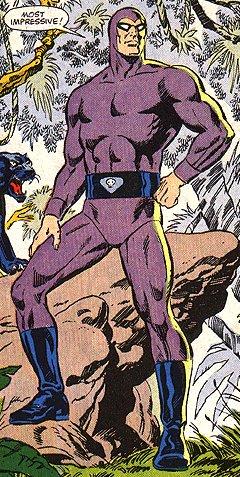
Kai Friese had the compleat Phantom history taped in this essay from Transition:
The jungle was stirring; the natives, as always, were restless. By the time the Illustrated Weekly began to print Phantom, the end of the Empire was at hand; the sun was setting in the East. And back at Phantom HQ, otherwise known as King Features Syndicate (a division of the Hearst Corporation), the editors made a number of changes to accommodate the sensibilities of their burgeoning Indian readership. Bengal had become first Bengali, and then Bangalla. To avoid any confusion with Hinduism's favorite hero, the Phantom's enemy Rama became Ramalu. The Pirate Singh Brotherhood, whose name was -- however inadvertently -- guaranteed to offend both the Rajput and Sikh communities, became the Singa Pirates. Until, finally, only one diminutive trace of our hero's original landfall remained: the Phantom's pygmy friends, the Bandar, whose tribal name Falk had lifted from the Jungle Book. They were still the Bandar log, the monkey people. After all, there are no pygmies in India.
posted by Hurree |
9/09/2005 12:04:00 AM


