Life happened because I turned the pages~~Alberto Manguel

Saturday, May 27, 2006

"Dig it out!": Seamus Heaney

Seamus Heaney talks to Sam Leith about poetry:


In 1963, he found Hughes' Lupercal in the Belfast public library.
"I will always remember taking it down, and opening it at View of a Pig, and - whooh! This was something I had known myself, and I thought it was secret, and nothing to do with modern poetry . . . as way back there in the Middle Ages . . . as Hardy, Jude the Obscure, pig-killing . . . had all been done, you know? And suddenly, here's Ted.
"I was electrified by the language. It wasn't a matter of subject matter, but of the transmission of the language. Patrick Kavanagh had an entirely different way. Kavanagh walked in like an old country neighbour coming into your kitchen without knocking (and) started to talk to you."
"Directness of utterance", and "command" are praise words for Heaney, but he also has a strong attachment to the poem as an object as much found as made. Finders Keepers was the title of his collected essays, and one of his "greatest hits", Digging - which, as the first poem in Death of a Naturalist, could scarcely escape the feel of a manifesto - sees the poet's task as excavation.
"I think of it as something found, all right. But you also have to make it." He chuckles. "Fundamentally, I think - I'm with Michelangelo in there, if you can find it. If you have an art. Dig it out!" The excavation begins with some sort of a donnee, a gift from the unconscious. "Otherwise I can't do it, to tell you the truth. It doesn't need to be much. The donnee can be made to work harder. It used to be I'd touch on the donnee and let it flare, you know - it was over quickly. What I like to do now is use it as an energy source, it moving a little bit further.


The Guardian's Culture Vulture attended Heaney's reading from his new book, District and Circle:

As a reader Heaney is careful and deliberate, giving the words time, weighing them, taking obvious pleasure in the unexpected - the tube engine that "evened", the ground-up turnip matter which collects "bucketful by glistering bucketful". The endings that hover so delicately or stamp so emphatically on the page are especially effective when read aloud, such as the final line of one of the best poems, The Lift, in which a group of women approached the coffin of the poet's aunt, "And claimed the final lift beneath the hawthorn".


You can listen to Seamus Heaney reading from his poems over here, at The Poetry Archive, or catch a video of his first reading at MIT here, or listen to his brilliant Nobel Prize lecture, 'Crediting Poetry', over here.

Thursday, May 11, 2006

Sebastian Junger and the Boston Strangler


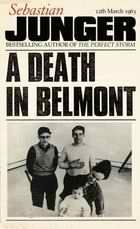
The child in the picture is Sebastian Junger, seen here with his mother; the man standing right behind her is Al DeSalvo, who had just finished a carpentry job for the family. The day before the photo had been taken, Boston resident Bessie Goldbberg had been murdered; a man called Roy Smith was charged and convicted of the crime. Just two years later, the Jungers' friendly carpenter confessed to being the Boston Strangler: he admitted to the murder of eight women, though not to killing Bessie Goldberg.


As The San Francisco Chronicle says in its review of Junger's book, A Death in Belmont:

"It's not every writer who can use a baby picture of himself with a confessed serial killer as the frontispiece of his latest book. Junger grew up believing that Smith was probably the scapegoat for DeSalvo. In "A Death in Belmont," he re-examines Goldberg's murder and the Boston stranglings, probing what he sees as an essential connection between them and troubling ambiguities about Smith's and DeSalvo's respective culpabilities. The result is a riveting -- but controversial -- mix of personal history, murder mystery and cultural record. It is also a fascinating legal primer on race and justice in America."


Junger's theory, that Smith may not have been the real murderer, is controversial. he was at the receiving end of vociferous criticism when he did a book reading in Portland recently, and Leah Goldberg, Bessie Goldberg's daughter, posted her views protesting Junger's findings on the Amazon page for A Death in Belmont. (The debate between friends of the Goldbergs and defenders of Junger went back and forth for a while.)

Perhaps the best analysis of Junger's book comes from Alan Dershowitz:

Popular nonfiction, of the kind Junger produces so expertly, tries to construct a narrative that emulates fiction by playing down coincidences and emphasizing connections. In real life, perfect storms are the rare exception, while in fiction they are the rule. To write a seamless nonfiction narrative, however, a perfect storm is desirable. If it has, in fact, occurred, as it did with the northeaster of 1991, that is fine. But when a writer has a stake in playing down coincidences and emphasizing connections, his work must be read with caution, especially when it contains no footnotes or endnotes.


If you're curious, here's a look at how another controversial non-fiction work about murder was received when it came out. Truman Capote's In Cold Blood set the bar for future authors, from John Berendt to Junger, though Capote was dealing with facts, not hypotheses.

Wednesday, May 10, 2006

Events: Baby Halder's book (Thursday, May 11)

Mail from Zubaan's Urvashi Butalia:

On the 11th of May Zubaan and Penguin India will be launching an
unusual book, and in an unusual way.

The book is called A Life Less Ordinary, and is an account of her life by Baby Halder, a young woman and a domestic worker in a home in Gurgaon. Baby wrote this book in Bengali some years ago when, encouraged by her employer Dr Prabodh Kumar she began to read afresh, and then to write.

Baby's life story is, in many ways, an "ordinary" one. From her difficult childhood, spent moving from place to place, coping with domestic responsibilities thrust upon her by an absentee father and a mother who abandoned the family when Baby was just a small child, to her marriage--at the age of 13 to a man nearly twice her age--and becoming a mother when she was still just a child herself.

However it is "less ordinary" in that she battled against the odds, left her violent and abusive husband, and determined to build a better life for herself and her children in an unknown city.

Baby's search for work led her finally to the home of Dr Prabodh Kumar, a retired professor and grandson of Premchand, the well-known Hindi and Urdu writer. With his encouragement and support she wrote her life story, which was published in Hindi and Bengali as Aalo Aandhari, and became a bestseller in both languages.

On Thursday, 11th May, Zubaan and Penguin India, co-publishers of the English edition (translated by Urvashi Butalia, with an introduction by Sheela Reddy), will hold a special session of Zubaan's monthly programme, Words of Women, where we will show a short (24 minutes) film on Baby, which will be followed by a conversation between Baby Halder and actor and activist Nandita Das. The evening will begin with tea at 6.30 pm, and the actual programme (roughly an hour and a half) at 7 pm. It will be held at the Habitat Centre in the Casuarina Room in the basement.

We do hope you will come. We're proud to be publishing this book, which
comes from someone not used to words, or indeed to writing, someone who
belongs to a group that is usually voiceless. We'd like to honour Baby
for her courage and determination. We'd like to ask you to join us in
welcoming a new and unusual writer into the world of books.

Tuesday, May 09, 2006

Whispers in the dark

From Orhan Pamuk's PEN Arthur Miller Freedom To Write Memorial Lecture:

In March 1985 Arthur Miller and Harold Pinter made a trip together to Istanbul. At the time, they were perhaps the two most important names in world theater, but unfortunately, it was not a play or a literary event that brought them to Istanbul, but the ruthless limits being set on freedom of expression in Turkey at that time, and the many writers languishing in prison. In 1980 there was a coup in Turkey, and hundreds of thousands of people were thrown into prison, and as always, it was writers who were persecuted most vigorously. Whenever I've looked through the newspaper archives and the almanacs of that time to remind myself what it was like in those days, I soon come across the image that defines that era for most of us: men sitting in a courtroom, flanked by gendarmes, their heads shaven, frowning as their case proceeds.... There were many writers among them, and Miller and Pinter had come to Istanbul to meet with them and their families, to offer them assistance, and to bring their plight to the attention of the world. Their trip had been arranged by PEN in conjunction with the Helsinki Watch Committee. I went to the airport to meet them, because a friend of mine and I were to be their guides.
...Together we visited small and struggling publishing houses, cluttered newsrooms, and the dark and dusty headquarters of small magazines that were on the verge of shutting down; we went from house to house, and restaurant to restaurant, to meet with writers in trouble and their families. Until then I had stood on the margins of the political world, never entering unless coerced, but now, as I listened to suffocating tales of repression, cruelty, and outright evil, I felt drawn to this world through guilt— drawn to it, too, by feelings of solidarity, but at the same time I felt an equal and opposite desire to protect myself from all this, and to do nothing in life but write beautiful novels. ...But I clearly remember one image: at one end of a very long corridor in the Istanbul Hilton, my friend and I are whispering to each other with some agitation, while at the other end, Miller and Pinter are whispering in the shadows with the same dark intensity. This image remained engraved in my troubled mind, I think, because it illustrated the great distance between our complicated histories and theirs, while suggesting at the same time that a consoling solidarity among writers was possible.

L-O-N-D-O-N, London

Reviews of Gautam Malkani's Londonstani, spot the common denominator:

(The Independent): There are a number of reasons to feel dubious about Londonstani. First up, it's marketed as a street-level transmission from elusive old multicultural Britain, that El Dorado of the publishing world that publishers claim, year after year, to have located in yet another sluggish tale of love and loss in London. Second, it's a story of teenage rudeboys on the streets of Hounslow that's written, somewhat paradoxically, by the Cambridge-educated editor of the Financial Times Creative Business pages. Third, it's narrated in an admixture of txtspk, gangsta rap and various forms of slang ("U hear wot ma bredren Jas b chattin?") that will baffle non-Playstation generations and make anyone sigh who ever raised an eyebrow at Irvine Welsh.

(Scotsman): GAUTAM Malkani had already been branded the Asian Irvine Welsh months before his debut novel, Londonstani, swaggered on the scene.

(The Times Online--they had fun, they took Londonstani off to Miss Coakley's sixth-form English class to see how it would fly): Although Londonstani does not shy away from difficult storylines — painful marriages, cross-cultural violence, religious tension, suicide — something in Malkani’s portrayal is a touch simplistic. It may be a side-effect of the linguistic restrictions that he has imposed on himself, but there is a cartoonish element in the incessant chat, and a distinct lack of character development that makes the more serious threads hard to follow. It is not necessarily an unfamiliar ear that holds you back; you don’t have to be a Dubliner to love Roddy Doyle or a skag-head to enjoy Irvine Welsh. It could have been the same with Londonstani.

And have the reviewers reached a verdict, Milord?

Um.

Niall Griffiths in The Telegraph:

It begins badly. Very badly, like this:- Serve him right he got his muthafuckin face fuck'd, shudn't b callin me a Paki, innit.
After spittin his words out Hardjit stopped for a second, like he expected us to write em down or someshit. Then he sticks in an exclamation mark by kickin the white kid in the face again.
- Shudn't b callin us Pakis, innit, u dirrty gora.
It's hateful, that sort of opening. It says: look at me, see how tough I am, how real, how the label "hard-hitting" was made for me, see how much attention I paid in sixth-form creative-writing classes when the teacher told us that an arresting opening was important.


And here's Kamila Shamsie in The Guardian:

It says much for the effectiveness of the opening chapter of Gautam Malkani's much-hyped debut that, within a few pages, I was prepared to shut out those alarm bells and simply fall into the world of the novel.
It is, to start with, gripping stuff....The voice introduced in this opening chapter is a fascinating one: a narrator whose former friends are "coconuts" (brown outside, white inside), who wants more than anything else to be accepted by the "rudeboys" and to scrub off everything - diction, friends, former mentors, education - which remains of his previous life. It's a story about certain myths of masculinity that both attract and weigh upon young men, warping their relationship with the world. Ethnicity gives this narrative a particular context, but it is not a story about migrant communities, no matter what the hype might suggest. It is clear early on that gender rather than ethnicity is at the heart of this novel.
Unfortunately, Londonstani largely fails to live up to the promise of the opening chapter.


And we missed linking to this because we're lazy and directionless, but here's Sarfraz Manzoor on The Meaning Of It All (okay, jokes apart, read the man--he makes several key points):

There is both danger and irony in the way that Asian writers are being treated. The danger is that claims of authenticity are easily challenged. Monica Ali's Brick Lane was criticised by some of those living in east London as being inaccurate; Ali herself was berated for not coming from Brick Lane itself (although Ali never claimed to be anything other than who she was). Tony White, on the other hand, was not challenged on why he had chosen to write about young Bangladeshis, and no one asked white film director Saul Dibb what gave him the right to depict the world of gun crime among London's young blacks in Bullet Boy. Will anyone question Dominic Savage's credentials to make his film Love + Hate, in cinemas from Friday, which concerns a love affair between a Muslim girl and a white skinhead? If you are white and middle-class, it seems, you are allowed to be an artist; if you are Asian, you must be authentic.
The irony is that while the media craves authenticity and wants, for example, to hear the genuine voice of disaffected Muslim males, these youths are usually neither able or willing to tell their stories. Next week's Bradford Riots was not written and directed by the kind of working-class Pakistani Muslim around whom the drama revolves, but by Neil Biswas, who is undoubtedly talented but is an Oxford-educated Hindu Bengali living in London.

Whorf and the Pirahas

From Spiegel, a curious piece on a language that lives in the present (link whacked from ALDaily:

Everett came up with a surprising explanation for the peculiarities of the Pirahã idiom. "The language is created by the culture," says the linguist. He explains the core of Pirahã culture with a simple formula: "Live here and now." The only thing of importance that is worth communicating to others is what is being experienced at that very moment. "All experience is anchored in the presence," says Everett, who believes this carpe-diem culture doesn't allow for abstract thought or complicated connections to the past -- limiting the language accordingly.
Living in the now also fits with the fact that the Pirahã don't appear to have a creation myth explaining existence. When asked, they simply reply: "Everything is the same, things always are." The mothers also don't tell their children fairy tales -- actually nobody tells any kind of stories. No one paints and there is no art.


The Independent's story is here.

You're going to hear Benjamin Whorf's name a lot in conjunction with the new findings about the Pirahas, partly for these reasons.

Friday, May 05, 2006

Gone with the Whinge

First, read this:

Garrison Keillor:

OK, let me say this once and get it off my chest and never mention it again. I have had it with writers who talk about how painful and harrowing and exhausting and ALMOST IMPOSSIBLE it is for them to put words on paper and how they pace a hole in the carpet, anguish writ large on their marshmallow faces, and feel lucky to have written an entire sentence or two by the end of the day.
It's the purest form of arrogance: Lest you don't notice what a brilliant artist I am, let me tell you how I agonize over my work. To which I say: Get a job. Try teaching eighth-grade English, five classes a day, 35 kids in a class, from September to June, and then tell us about suffering.
The fact of the matter is that the people who struggle most with writing are drunks. They get hammered at night and in the morning their heads are full of pain and adverbs. Writing is hard for them, but so would golf be, or planting alfalfa, or assembling parts in a factory.


Then, read this:

From John Scalzi's Utterly Useless Writing Advice:

5. Okay, we got it -- writing professionally is endless pain and suffering.

Well, no. Sorry to sound so strident. Writing professionally, even at its worst, still beats the hell out of lifting heavy objects off the back of a loading dock for $10 an hour. Let's not kid ourselves, here: It's not a hard life, relative to what other people have to do. This is no doubt part of the reason so many people want to be professional writers.


and:

7. What if I send something out and it gets rejected?

What do you mean "if"?


And there's this, about Scalzi's new book:

Just as an FYI for all y'all, I've made a change to the title of the writing book. It is now:

You're Not Fooling Anyone When You Take Your Laptop to a Coffee Shop: Scalzi on Writing


Yes, it's long. So what. I like it. Although I do like the runner-up, too: "Sailing the Ramen Seas: Notes on the Writing Life." If Bill thinks the first title is too much, I'll fall back on the ramen. Which really is a writer thing to do, is it not.

You may like the chapter titles as well:

1. Writing Advice, or, Avoiding Real Work the John Scalzi Way
2. Yo Ho, Yo Ho, A Writer's Life For Me
3. The Schadenfreude Needle is Buried Deep Into the Red: On Writers
4. Science Fiction, or, Don't Skip This Chapter, You Goddamned Writing Snobs


So there you go, equipped with pretty much everything you need to write, whine, whine about writing or write about whining. Enjoy.

Pramoedya Ananta Toer dies

Tariq Ali pays tribute to Indonesian writer Pramoedya Ananta Toer, who died this week:

Toer, born in 1925 in Blora in central Java, was the country's most distinguished novelist and, significantly, published in the United States. His life was spared. The generals dared not execute him, but hoped that the conditions in which he was kept would take care of the problem.
Arrested after the military coup in Jakarta in 1965, he was sent to Buru island, a tropical gulag where many died of exhaustion, hard labour or starvation. Toer survived. He would later recall how every night, for three thousand and one nights (eight years), he fought against cruelty, disease and creeping insanity by telling stories to his fellow prisoners. It kept hope alive for him and them. As they listened, the prisoners momentarily forgot where they were or who had sentenced them.


More links:

--Reviews of All That Is Gone and The Girl From The Coast


--The New York Times obituary

--a photo-essay taken at his home


--The (very comprehensive) Pramoedya Ananta Toer page

Browser failure?

The Guardian reports on Mumbai's endangered pavement booksellers:

Amin has become a spokesperson for the booksellers, licensed and otherwise. He helped create the Mumbai Booksellers Association, a trade group that has protested and started a petition drive to attract public and political support. (They put up placards with such questions as "Are books polluting? Are books a menace?") The delays to select a specific book-hawking zone may even be a strategy to defeat the industry, he says. "There will be very few booksellers left by the time the government finds us a new place," he said. "We have a Fashion Street - why not a Book Street?"


I like the little bureaucratic detail about the reduction in fines on account of the nature of the material, so to speak:

The municipal group did originally impose a standard penalty of 300,000 Rs (£3,900) for the return of the confiscated goods last summer, he says, but the fine was later reduced to 28,000 Rs (£387) because of the "intellectual nature" of the seized property.


The Scotsman explores the perverse appeal of secondhand bookshops:

In a real bookshop, the price of each volume is written in pencil on the fly leaf. A slight mustiness is de rigueur. If you purchase three or more books and point out some dilapidation in one, a discount may graciously be awarded.
What has so far been described is the idyllic situation where the bookshop owner is congenial. Yet it is a profession that notoriously attracts eccentrics. This was forensically documented in the sporadic series Drif's Guide to the Secondhand and Antiquarian Bookshops in Britain, last published in 1995. Drif briefly expounded his philosophy: "In wine bars they have a happy hour - the secondhand bookshop equivalent is different, it's called the surly hour and it lasts all day."

Thursday, May 04, 2006

Is this where the writer lives?

Roger Mudd revisits Eudora Welty's home:


"Like most Southern women of her age, Eudora regarded her bedroom as a place of privacy.
When she typed she was close enough to her windows that passers-by, if they knew to look up, could see one of America's finest writers at work — no ordinary treat. As her fame spread, more people knew to look up and more of them rang the bell with copies of her books for her to autograph. One early morning, she told me, "a jogger came by, bouncing up and down in his jogging suit," carrying a book for her to sign. She smiled, remembering the incongruity of the scene."


Rajnish Wattas goes in search of R K Narayan's home:

"From a distance I espied an old house in white plastered finish with an apsidal end wall! Yes that was it, I knew. Its rather tumbledown condition, an unkempt garden with overgrown weeds, and a locked gate were telltale signs of its empty soul. To make sure, I confirmed the owner's name from the neighbour, which was now a fashion store! Wonder, what Narayan would have made of his new neighbours!"


And Jay Parini tells us why he's fascinated by writers' homes, from Faulkner to Frost, Graham Greene to Gore Vidal:

"Quite recently I stopped by Bateman's, Rudyard Kipling's 17th-century manor house in east Sussex, and I've also been to his massive clapboard house in Brattleboro, Vermont - where (somewhat incongruously) he wrote The Jungle Books at a desk overlooking a snow-filled pasture. A few year ago, on a visit to Key West, in Florida, I sat by the pool at Hemingway's tropical villa, with its countless wild cats and dense palm enclosure. One can easily imagine Papa up in his study, sweating over the proofs of For Whom the Bell Tolls. On a recent visit to Oxford, Mississippi, I sat at William Faulkner's rickety desk at Rowan Oak, his antebellum house, observing the peculiar light in August - which gave rise to the title of a novel (although the phrase also may refer to the fact that a pregnant cow may be "light" of its foal or calf in August if it should give birth in that month)."

Amit C is from Mars, Willy D is from Venus

Just catching up:

--Amit Chaudhuri discovers that William Dalrymple and he come from different planets: "Unlike some of the other participants, who could be alternately voluble and reticent about their culture, Dalrymple is never stingy about giving us news of his planet. It is, by all accounts, an alluring place, because things that are muddled on my planet are, in Dalrymple's, humblingly clear."

--(William Dalrymple, according to this report, shares his planet with Hugh Fearnley-Whittinstall, which is a name I wish I could claim to have made up, except that I didn't: anyway, this is the planet of the embarrassingly large book contract.)

More seriously, Zubaan wants you

Talented, female, Asian, not into plagiarising, got new, original fiction? The good people over at Zubaan need you. I know they're not going to say this, but their standards are pretty high, so don't submit anything that's only slush-pile average; send them your best.

Here's what it's all about:


THE ZUBAAN BOOK OF NEW WRITING BY YOUNG WOMEN
(working title only)


Concept note


Zubaan is planning to produce an anthology of short fiction showcasing new, young women writers from South Asia.
The criteria

* The focus of the book will be on young writers in the 20s and 30s.
* The writers should be women of South Asian extraction, but may be based anywhere in the world. We are interested in non-resident Indian writers as well as those based in India.
* Stories can be of any length up, ideally anywhere between 2-5,000 words and should be complete stand-alone narratives.
* All submissions must be in English.
* The anthology will be of fictional writing, and we are keen to include a variety of genres – from humourous pieces to science fiction, fantasy, detective stories, and other forms which may fall under the general rubric of ‘speculative fiction’.
* Preference will be given to unpublished stories.

Selection

Selection will be on merit, and the stories would be read by Zubaan’s in-house editorial team. The final selection for inclusion would rest with the Editor.


Submission

Complete stories should be sent as word attachments to:

Zubaanwbooks@vsnl.com

with the subject line “Submission for Young Writers Anthology”. Along with the story, writers should email a short biography about themselves, including details of their published writings (if any).

Publication


Responsibility for the editing, design, production and sales of the book rests with the Publishers.

Copyright for individual pieces would rest with the respective authors, but rights in the anthology as a whole would rest with the publishers, who will actively pursue the sale of translation and co-publication rights for the book.
Payment

All writers selected will receive a modest fee for their work.

Deadline

All submissions should be received by July 31st 2006

ABOUT ZUBAAN

Zubaan is a small independent feminist publisher, based in New Delhi. Headed by Urvashi Butalia, who co-founded India’s first feminist press, Kali for Women, Zubaan is committed to publishing books by, for, on or about women – and women’s issues – in South Asia for an international market. For further details, and a list of books published thus far, please refer to: www.zubaanbooks.com

Stunning New Kaavya Revelations

In a shocking, exclusive expose, The Harvard Scarlet & Mauve revealed that Kaavya Viswanathan has not plagiarised from any of these books: Lolita, Thomas the Tank Engine, The Ruhnama, Gulliver's Travels or, indeed, the classic text Chemistry: A Practical Handbook.
Initially her publishers said that the omissions would be corrected in a second, more inclusive edition of the book, until a journalist pointed out that Opal Mehta had been officially pulled from bookstores. A representative of the New York book packaging agency, however, said that the lack of unconscious borrowings across several prominent literary genres was regrettable, and that it might be rectified--but by another author. She refused to confirm that the agency had its eye on a young Columbia sophomore this time, but admitted that discussions had stalled "for technical reasons". "We have worked out the packaging fees successfully," she said, "but there's an additional charge for author giftwrapping, and we hope to work that out amicably."
Meanwhile, the estate of the late Barbara Cartland said it was considering suing the young and unfortunately discredited genius. "Dame Cartland was the pioneer of romantic fiction; you might even call her the Mother of Chick Lit. We are disappointed, dismayed and distressed to see that this young author did not internalise a single line of her work: not even a few ellipses..." said a legal representative.

Coming up: "Kaavya stole my name!" cries Ruby Mehtab. But is Ruby truly the original for Opal Mehta... or does that distinction belong to--Pearl Mehra? Find out in further episodes of the KV saga, sponsored by Cryptomnesia Inc.

And courtesy The New York Times, a look at how closely J Kenney's The Great Gatsby might resemble The Great Gatsby:

MR. KING Are there similarities between your new novel, "The Great Gatsby" and "The Great Gatsby" by F. Scott Fitzgerald?

MR. KENNEY Not so much "similarities." They're actually identical.

MR. KING I see.

MR. KENNEY Except for my name as author...