Life happened because I turned the pages~~Alberto Manguel

Sunday, January 28, 2007

Hutom in the 21st century


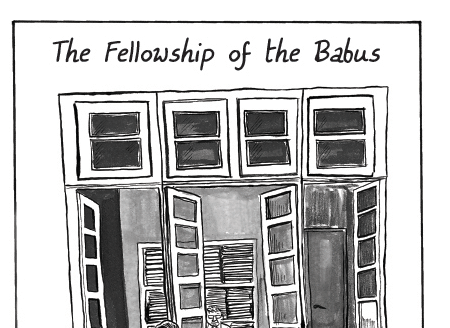
I've just added Sarnath Banerjee's website to the sidebar, in the authors' section. He introduced the graphic novel to India when he came out with Corridor some years ago, and is back with The Barn Owl's Wondrous Capers, which blends the satirical sketches of the 19th century Bengali writer Kaliprassana Singha with the story of the Wandering Jew, brought up to date in 21st century Calcutta. Go read.

Jaipur Literature Festival: poets (2)


One of the more pleasant surprises at the Jaipur festival was discovering the work of Tishani Doshi (previous post on Kitabkhana here). Tishani trained as a dancer with Chandralekha for several years, and perhaps this gives her a more liberating view of the body than most. Anita Roy drew her out on several subjects, and spoke at one point of women's dilemmas--motherhood, the messiness of the body. Tishani came back with a different viewpoint, borrowed freely from Chandralekha's philosophy of the human body as the microcosm of the universe, of discovering and unleashing its power.

Here's a bit from 'Homecoming', in her collection of poems, Countries of the Body:

"I forgot how Madras loves noise
Loves neighbours and pregnant women
And Gods and babies....

....How cars in reverse sing Jingle Bells
And scooters have larynxes of lorries.
How even colour can never be quiet."

Here's a link to 'Ode to Drowning'.

And here's the opening verse from 'On the Burning of An Unfamiliar Aunt':

"My family gathers around to mourn,
But mainly to whisper
How killing yourself
Amounts to confessing
Life somehow got too much for you."

Jaipur Literature Festival: poets (1)

The convent school I attended in Delhi had firm views on How Poetry Should Be Read. We were supposed to stand "like Horatio at the bridge, girls!", elbows out and hands clasped together, and read "with nobility in your hearts". My only attempt at reading was a disaster.
"Look soulful."
(This was hard to do. I'd been allotted a particularly twee Sarojini Naidu verse--"Lightly o lightly we bear her along/ She sways like a flower in the wind of our song"--and was trying not to think of the parody: "Heavily o heavily we bear her along/ She should have skipped lunch, the silly fat Bong.")
"Think of the beauty of those immortal lines. Now look soulful."
(With much effort, I produce an expression redolent of terminal constipation.)
"No, no, look soulful! Think beautiful thoughts!" (In an aside to another teacher: "I fear this one is not spiritual enough, Rekha.")

What I liked most about the poetry reading session in tribute to Dom Moraes, Nissim Ezekiel and Arun Kolatkar at last week's Jaipur festival was that the three readers--Keki Daruwalla, Jane Bhandari and Jeet Thayil--had clearly not attended my convent school.
Keki pulled off the difficult feat of reading Nissim's over-anthologised Night of the Scorpion as though he was listening to the words for the first time. There are poems that are ruined because they've become too familiar--Wordsworth's Daffodils, Auden's Stop All The Clocks--and for my generation, it's hard to read 'Night of the Scorpion' without hearing a faint echo of the perfect, merciless parody: "I remember the night my mother bit the scorpion."
The hall was packed, and Antara Dev Sen, moderating the session, allowed the three poets on stage to remember their three absent colleagues in the way they preferred. Space Bar, Middle Stage and me enjoyed ourselves thoroughly, and I think poetry made two new converts out of two old sceptics, Jabberwock and India Uncut.
There were moments of sadness: Keki speaking of all the poets we've lost in a relatively short period--so very many of them, so many of them his friends as well as his peers--Arun, Dom, Nissim, also Agha Shahid Ali, A K Ramanujan, a handful of others.
There were small moments of revelation: Jane Bhandari talking about meeting Arun Kolatkar at the Wayside Inn in Kala Ghoda, Jeet Thayil giving us the stories behind Madhu Kapparath's photographs of the Bombay poets. Kolatkar's house was so tiny, he said, that guests had to be entertained on the equally tiny balcony or at his "office", the Wayside Inn, where he was to be found at the same table for years. Dom Moraes caught sitting at his typewriter at the exact moment that the genial, jesting raconteur melts away, revealing the forceful writer underneath.
The session closed with Jeet, Keki and Jane reading from their own poems. I particularly enjoyed Jeet's playful ghazal on Malayalam (excerpts reproduced here with the author's kind permission):

Ghazal: Jeet Thayil


Listen! Someone's saying a prayer in Malayalam.
He says there's no word for 'despair' in Malayalam.

Sometimes at daybreak you sing a Gujarati garba.
At night you open your hair in Malayalam....

...Visitors are welcome in The School of Lost Tongues.
Someone's endowed a high chair in Malayalam.

I greet you my ancestors, O scholars and linguists.
My father who recites Baudelaire in Malayalam.

Jeet, such drama with the scraps that you know.
Write a couplet, if you dare, in Malayalam.

Thursday, January 25, 2007

Kapuscinski's last journey

From The LA Weekly:

In The Soccer War, he recalls how, in Nigeria in 1966, he was "driving along a road where they say no white man can come back alive. I was driving to see if a white man could because I had to experience everything for myself." At the first roadblock, he was beaten and allowed to drive on after he had paid a toll. At the second road block, he was beaten again, doused in benzene but, after handing over the rest of his money, allowed to drive on rather than being set alight. Which meant that by the time he came to the third roadblock, he was penniless and highly inflammable.


From the II Journal:
The limitation of sources under the Communists had a very political effect on reading. People had just one book, and nothing else — no television or other diversions — so they just read the same book very carefully several times. Readership was high, and very attentive. It was people's only source of knowledge about the world. You have to understand that the tradition of Russian literature — and Russians are great readers — is also an eastern tradition of learning poetry and prose by heart. This is the most intimate relationship between literature and its readers: they treat the text as a part of themselves, as a possession. This art of reading, reading the text behind the text, is missing now.


An extract from Shadow of the Sun:
I asked John and Zado to take me to a hotel. They drove me to a shabby, two-storey building. The entrance was through a bar. John opened the door but could go no further. Inside, in the artificial coloured twilight and hot stagnant air of the small room, stood about 100 prostitutes: sweaty, exhausted, and so tightly pressed together, jammed in, that one could scarcely push one's hand in, let alone enter. It worked this way: if a client opened the door from the street, the pressure inside propelled one of the girls, as though from a catapult, straight into the arms of the surprised customer. Then another girl took her place near the exit.


From an acceptance speech for a prize:
It was enough to be familiar with European culture - enough just to be a European, born or naturalized - to feel oneself the master, lord of the house, the world's custodian. For this European needed no qualifications, no additional knowledge, no particular qualities of mind or character. I observed this still in the 1950s and 1960s in Africa and Asia. Some European, in his own country very average, even incompetent, and held in law regard, right away became a high commissioner, the chairman of a great concern, director of a hospital or school when he arrived in Malaysia or Malawi. The locals meekly listened to his injunctions, eager to absorb his remarks and theories. In the Belgian Congo the colonial authorities created a category, the so-called évolué, comprising those who had left the state of tribal "savageness" behind but did not yet deserve to be called Europeanized people. The évolué were something in between, on the way - Brussels attached the hope to them that thanks to effort, investment, patience and good will they would someday succeed in scaling the heights of Europeanness, and that meant the heights of humanity. In this excellent book Portrait du Colonisé précédé du Portrait du Colonizateur, Albert Memmi described the whole painful and humiliating process to which the évolué were subjected.
The 20th century was not only a century of totalitarian systems and wars. It was also the century of decolonization, of a great liberation. Three quarters of the residents of our planet freed themselves from colonial subjugation and - at least formally - became fully entitled citizens of the world. There never had been such an event in all history, and never will be again.


Ryszard Kapuscinski (1932-2007), one of the finest and most honest writers of our times, is done with his travels.

Wednesday, January 24, 2007

Jaipur Literature Festival-3

Back in Delhi, I caught up with Ira Pande, who read from Diddi, her book about her mother, the writer Shivani, at the festival. "There is something very special about reading in a place like Jaipur," she told me. "In the small towns, I don't have to explain who Shivani was, they know her work, and the local reader comes to hear about writers like her."

It was "local" readers who turned out in huge numbers for authors like Bhanu Bharti and Sheen Kaaf Nizam. It's true that some of the people who packed the hall for Sheen Kaaf Nizam's reading were there to keep their seats in anticipation of Rushdie's reading, which was on next, but as one of the organisers told me, "He is one of our best poets. People have come from Jodhpur and Udaipur just to hear him." I met one of Nizam's fans, quietly exiting the hall instead of waiting for Rushdie's reading: "After this poetry," the gentleman said, "I have no appetite for prose." Publisher and author Urvashi Butalia was a little upset at the imbalance between the two groups--the "Englishwallas" and the "desi writers". While Bhanu Bharti, Seemantini Raghav (who read from the works of her father, the late Range Raghav) and Anupam Mishra attended sessions by a range of English-language authors, the courtesy was not always reciprocated. It was the "local reader" who came through for their authors, instead. Sitting at the back of the hall during Anupam Mishra's session, what struck me was the involvement of the audience. Most of them had read his book, Aaj Bhi Khare Hain Talab, and all of them had strong opinions on his work. I left just before the Q&A session--Hindi is not my first or even second language, and the questions were difficult for me to follow--but took away the sense that this was probably one of the most enriching, if under-reported, sessions at the festival.

Here's Ira Pande on the "little languages":

"I can dream in all three languages, English, Hindi and Pahari.... Kumaoni has different words for smells, just as the Eskimos are said to have 17 different words for snow. There's a word for the smell of an imperfectly cleaned bathroom. A word for the smell of an unaired room. I worry about the little languages. Hindi, Marathi, Bengali-these will always survive. But the little languages, like Kumaoni, that provided so much richness and texture to our lives, these are dying... "

Monday, January 22, 2007

Jaipur Literature Festival-2

From Salman Rushdie's chat with Barkha Dutt: (this is reasonably accurate, but is not a complete transcript--taken from handwritten notes, so a few words and phrases are missing here and there.)

Rushdie on the travelling performers or bhaands of Kashmir:

In 1987, I went to Kashmir to make a documentary.... met the bhaands, went to their village and stayed with them.

We found that we would not tell the truth when the camera was running. They'd tell us all about an encounter with the Indian army, and then we'd start the camera:

"So tell us the story about what happened with Colonel so-and-so."
"No, no, no, nothing happened. Indian army, no problem. We love the Indian army."
"Cut". (Camera stops.)
"So tell us what happened with the Indian army?" (Long description of horrific encounter with the army follows. The film crew explains that they are now going to start the cameras.)
"So tell us the story about what happened with Colonel so-and-so."
"No, no, no, nothing to tell. Indian army, no problem."


Rushdie on the Indian army:

"The Indian army [in Kashmir] has behaved absolutely dreadfully."

In response to a question about whether he should have been so hard on the Indian army when officers were just following orders:

"Because 'I was only doing my job' was not an excuse in Nuremberg."

On Chhagan Bhujpal, former BJP leader, now a Congress minister, whom Rushdie interviewed for a documentary:

"He was, you know, an asshole."
"He spoke in very clearly racist, communalist and fascist language."
Bhujbal was anxious that some things should not appear in the official documentary.
"He said, 'racism is okay, because we are racist. Fascism is okay, because we are fascist.'" But Bhujbal didn't want to be photographed with his telephone.
"On his desk was a telephone in the shape of a green plastic frog, and when it rang it said 'Croak! Croak!' He didn't want pictures of the frog pressed to his face; and when you see a man talking to a green plastic frog, he is humbled. It's difficult to hate him."

Rushdie on meeting a fan in Egypt:

"So this man came up to me and said, Rushdie! Rushdie!
I said, yes, yes?
He said, I read That Book!
I said, oh.
He said, I like That Book! It's banned in Egypt! It's TOTALLY banned! But everyone has read it!" (Then Rushdie quotes from Mikhail Bulgakov: "Manuscripts don't burn.")

Rushdie on his parents, on Islam and on growing up among "extremely practising but incredibly open-minded" Muslims:

"My father was better at unbelieving. My mother was better at golf. In her old age, she did begin to get religion. It was kind of like arthritis..."

Rushdie was 13-and-a-half when he went to England and turned agnostic during a Latin lesson at Rugby--he was staring at the chapel, an ugly "great rocketship" to his eyes that "were trained by India". He thought, "What kind of god could live in a house as ugly as that?"
"By the end of the lesson, I had lost god. I went to the canteen and I ordered a ham sandwich. It wasn't very good ham, but I ate it. And there were no thunderbolts. And I thought, what kind of god is it who doesn't kill you for eating a ham sandwich?"

"My father wanted to rearrange the Koran--he believed the surahs were in the wrong order. He would discuss this with my grandfather, my father drinking whisky and my grandfather not.
He never did rewrite the Koran. Or The Trouble [a reference to the fatwa] would have arrived sooner."

On the burkha: "It's a one-woman tent! Maybe it's not such a good idea to put half the human race in a bag."

When Barkha suggests that perhaps he should worry about being so outspoken:
"What are they going to do, sentence me to death?"

Rushdie on being an author in the 21st century:

"If you look at books published in the 18th century...the title page of Robinson Crusoe has 'Robinson Crusoe: The Life and Strange Surprising Adventures of Robinson Crusoe of York, Mariner etc etc' (nb: the full title continues "...who lived Eight and Twenty Years, all alone in an uninhabited Island on the coast of America, near the Mouth of the Great River of Oroonoque; Having been cast on Shore by Shipwreck, wherein all the Men perished but himself. With An Account how he was at last as strangely deliver'd by Pirates. Written by Himself.")in very large type with Daniel Defoe's name in tiny letters. It's the same with Gulliver's Travels--there's 'Jonathan Swift' in small letters. Tristram Shandy: Sterne's name in small letters.
The books could go out and be famous, the authors could stay home and write.
There is now in our lives a public dimension that we can't escape.... But most of my life is not spent in public--it's spent with family and old friends...."

Rushdie on the difference between journalism and the novel:

"Let me read you this item from Bibliophile (Outlook's gossip column on books): 'Not everyone is delighted at the prospect of Salman Rushdie descending on Jaipur's litfest. The fatwa-ridden litstar is a security nightmare, and police plan to seal him up in an undisclosed hotel room until it's his turn to sing for his supper at the litfest.'"
Rushdie, who's been ambling around the festival grounds, signing autographs and chatting with fans for the last two days, gestures at the crowds sitting practically in his lap.
"As you see around you--security blanket! When writers write books, on the front page it says 'a novel'. They tell you it's made up. It's fiction."

Barkha, rising to the defence of journalists:
"How would you feel if you were completely ignored?"
Rushdie, unperturbed:
"Why don't you try it and see?"

Rushdie on Karachi:

"Well. I really don't like Karachi. It's a dump. It used to be a little dump, now it's a bloody big dump. My parents are buried there, but owing to the current crisis, I cannot visit their graves."

Rushdie on producing Edward Albee's Zoo Story for Pakistan television:


"This was when I wanted to be an actor. I suggested Zoo Story to them on the grounds that it would be very cheap--it was 50 minutes long, needed just two actors, and was performed on a bare stage with just a park bench.
Then we got to the scene where Jerry feeds six hamburgers to the dog, and the man from PTV said:
"No, no, no, the word 'pork'--pork is a four-letter word."

Rushdie argued that in the script it is very bad pork in the hamburgers, so bad that even the dog won't eat the burgers, so perhaps this should be seen as an anti-pork statement. The censor won't budge, though, so pork is replaced with a less offensive meat. Then they come to a scene where the word 'sex' is repeated thrice.

"No, no, no, the word sex--sex is a four-letter word."

Rushdie argues that the scene is crucial, that the word sex is necessary.
"No, no, no. The word 'sex' cannot be said on Pakistan television."
"But the scene?"
"No, no, scene is okay. But no sex."

So that's why Zoo Story is produced in Pakistan with the word 'sex' replaced serially by "desire", "lust" and "love".

Unfortunately for us, and fortunately for Rushdie, the tape was wiped.

"So nobody will ever see my Jerry," he says, looking greatly relieved.

Jaipur Literature Festival-I

Things you should know about Diggi Palace (the festival venue):

1. It has an official palace cat. And an unofficial one that has a bell round its neck. It was apparently the unofficial one who dropped by Amit Chaudhuri's morning session, looked up at the moderator--Anita Roy--fell in love with her at first sight, and sprayed the back of her chair as a sign of its devotion while meowing ecstatically. Cat was deeply interested in what Amit had to say about Arun Kolatkar's Jejuri (more on that later), but left when he refused to sing for the audience.

2. Do not use the tiny, tiny loos near the deck chairs (do, however, use the deck chairs, they're fun), unless you're a woman who likes hassling the men by going into the loo marked MALE in fierce letters. Use the barn-sized loo outside the auditorium where you can see the dim figures of audience and speakers through the stained glass. It has beautiful acoustics: you can hear them, but they can't hear you.

3. The rooms are actually quite nice, despite the author who said in slightly despairing tones:

"My room is full of old-world charm."

We looked at him questioningly.

"I prefer new-world convenience."

4. The man who sells cigarettes, matches and other essentials of life (right opposite the teeny-tiny loo) is also a miniaturist--who in Jaipur isn't?--and will sell you cards and/ or paintings on a grain of rice if you ask nicely.

5. Speaking of old-world charm, Diggi Palace is awash in the stuff. The only place in Jaipur's we-have-a-haveli-and-a-niwas-on-every-street environs that can compete is the wonderfully named Tomato Palace--I have no idea what it looks like, but who wants to stay at the Rambagh or Loharu House when you can say, "Me? I'm at Tomato Palace. Come and we'll ketchup on the gossip."

6. But the Diggi Palace has an unbeatable ace up its sleeve: horses, and rather lovely ones at that, stabled close to the lawns. "Ooh, how romantic," said one lady, but that was before the wind shifted and perfumed our lunch with strong gusts of equine sweat.

Thursday, January 18, 2007

Jaipurnama: off to the literature festival

I'm off to Jaipur for the Literature Festival--19th to the 21st, list of events here--tomorrow morning, in the company of a blarney of bloggers, lucky old me. (Insert alternate suggestion for collective noun for bloggers here: a bloodletting of bloggers, a bloat of bloggers...)

The list of participants includes:

Salman Rushdie, Kiran Desai, Baby Halder, William Dalrymple, Suketu Mehta, Kiran Nagarkar, Amit Chaudhuri, Christopher Kremmer, John Zubrzycki, Bhanu Bharti, Seemantini, Anupam Mishra, Ashok Vajpeyi, Jerry Pinto, Ira Pande, Shashi Deshpande, Feryal Ali Gauhar, Sheen Kaaf Nizam, Ravi Singh, Marc Parent, David Godwin, Keki Daruwalla, Paro Anand, Atanu Roy, Dr. Hari Krishna Devsare, Jugal Mody, Jeet Thayil, Jane Bhandari.


Which means much enjoyment will be had by all. Especially since Jaipur's Lit Fest departs from the bizarre but persistent Indian belief that the thing to do when you get a bunch of writers together is to get them onto six-member panels discussing incredibly boring subjects. Instead, they believe that the thing to do with writers is to let them talk to the audience. Heresy, I know, but it should be fun.

'utch xword awards: fiction

The Hutch Crossword shortlists for the 2007 awards have been announced.

English fiction:

Kunal Basu-Racists
Kiran Desai--The Inheritance of Loss
Vikram Chandra--Sacred Games
Rajorshi Chakraborti--Or The Day Seizes You
Manju Kapur--Home
Gautam Malkani--Londonstani
Kalpana Swaminathan-Bougainvillea House

Thursday, January 04, 2007

"A global, not an American, century"

From Pico Iyer's New Year's Day piece in the LA Times:

"The e-mails keep streaming in, here in my little apartment in Japan, from friends in California and places farther east. The world is unraveling daily, they say; we're going through a period of darkness unprecedented in our history. The war against terrorism is a war without end, in effect; the strikes of 9/11 have put us all on edge, even on trial, for life...
...The cries I hear in my friends' voices are those of conscience, and there's something stirring in their concern about America's war-mongering and injustices.
And yet, I feel like saying, America — though still the strongest power in the world — is by no means the largest or even the central one. One in every three people on our planet lives in China or India, and for those worthy souls, the new century is a time of possibilities unimagined before. There is corruption and oppression and pollution all over China; India is still a byword for suffering and poverty; and yet, for well over 2 billion of our neighbors in the global village, history is moving in a positive direction right now."

The post "spice and curry" generation

Claudia Kramatschek writes about the new landscape of Indian writing in English. She mentions Rana Dasgupta, Altaf Tyrewala, Samit Basu, Sarnath Banerjee and several others:

Many Indian authors - especially younger ones - will tell you that they experience a certain pressure, strengthened by internationally active publishers, to act as cultural ambassadors. In other words, either to turn out "spice and curry" in the form of easily-digestible novels of the exotic variety, or else elucidations of "Indianness" as such.
But a younger generation of authors now appears to have emerged in the English-language literary sector whose common development manifests a kind of caesura. All are between 25 and 35 years of age – a fact while in and of itself represents a minor revolution in a country where the aura of the senior writer has always shaped the literary canon. All came of age in an India where access to the wider world was available via mouseclick, and all feel at home within the most divergent cultures – and they play with this intercultural network in their literary work as well...

Shades of the Brontes

Justine Picardie visits the Bronte parsonage in the company of two psychics:

Before we go inside, Coral has already noticed something that interests her in the garden: two pine trees, one rather stunted, the other flourishing, on either side of what was once a gate that led from the parsonage to the churchyard. "Who planted those?" she says. "It's as if one signifies hope, and what might have been, and the other is of everything that was thwarted."
"Well, there's a story attached to them, possibly apocryphal," says Andrew. "They were supposed to have been planted by Charlotte and her husband, Arthur Bell Nicholls, just after they returned from their honeymoon." (They were married in 1854 on what Charlotte described as "that dim June morning"; her wedding veil and bonnet are still lovingly preserved in a glass case in the museum, touching relics of a short-lived marriage, for she died in March 1855, apparently in pregnancy, and her coffin was carried up the same church aisle that she had walked as a bride only nine months before.)

Who's Surrey now?

Too bad none of the William McGonagalls I know live in Surrey, B.C., or they could've picked up $75 by doing this:

"As part of the exhibition "The Art of the Sari," the Surrey Art Gallery is currently looking for poems written by B.C. writers that are inspired by the form and grace of the sari...Poems must be original, submitted in both languages, and accompanied by the name and address of the poet. Fees will be payable only to the author."

Before prats, wallys and tossers

The Oxford English Dictionary needs your help, to find out whether any of these words were in use earlier than the first reference they have to them.
So what were you before 1959, apparently the year the word "kinky" came into popular usage? Merely twisted? And does it matter, given that you wouldn't have known what to call a "marital aid" before 1976 or where to find a "pole dance" before 1992?